

Learning how to play poker starts with three things: knowing which hands win, understanding your betting options, and following the action in the right order. This guide covers all three, then walks you through Texas Hold’em from the blinds to the showdown.
You will also learn the basics of 5-Card Draw, 5-Card Stud, wild-card games, table etiquette, and beginner strategy. The same poker rules apply whether you play at home or use an online platform such as Shakebet.
What You Need to Play Poker
For a home game, you need a standard 52-card deck, chips, and at least two players. Chips make betting quicker and keep the pot easy to track. A banker or host manages the chip supply, handles buy-ins, and settles balances when the game ends.
Casinos may rotate two decks so the next hand can be prepared while the current one is played. Online, the software deals the cards and tracks each bet automatically. Before using any promotions for Poker at Shakebet, read the offer terms and check which poker games contribute towards wagering.
Poker Hand Rankings: What Beats What
Poker hand rankings remain broadly consistent across the major variants. Memorising the order is your first job because every betting decision depends on how strong your current hand is and what it could become.
When two players hold the same type of hand, compare the highest relevant cards. If both players have the same pair, for example, the highest unused card, known as the kicker, may decide the winner. If their best five-card hands are identical, they split the pot.
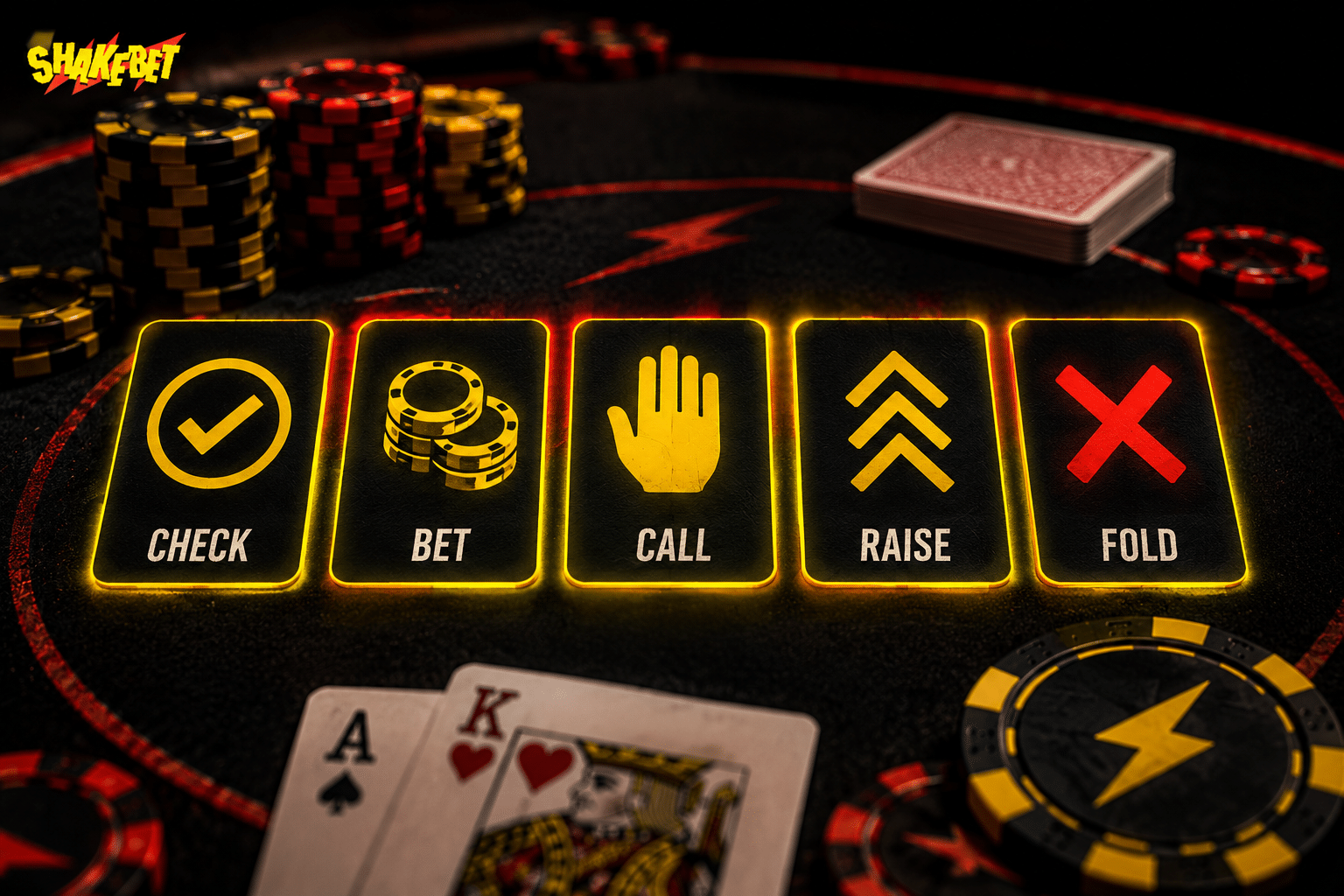
The Five Betting Actions
Betting gives poker its strategic depth. When the action reaches you, the choices available depend on whether another player has already bet and how many chips you have committed.
Check
Checking means passing the action without adding chips. You can check only when nobody has bet during the current round.
If another player bets after you check, the action may return to you. You must then call, raise, or fold.
Bet
A bet is the first wager made during a betting round. Once a player bets, everyone still in the hand must respond before the round can finish.
Call
Calling means matching the current bet. If another player bets $10, you put in $10 to remain in the hand.
Any chips you placed earlier in the same betting round count towards the required amount.
Raise
A raise increases the existing bet. The other active players must then call the new total, raise again, or fold.
Fold
Folding ends your involvement in the hand. You give up any claim to the pot and lose the chips you have already committed, but you do not have to add more.
The action continues clockwise until every active player has matched the highest bet or folded. If two or more players remain after the final betting round, they reveal their cards at the showdown.
Betting Structures: Fixed Limit, Pot Limit, and No Limit
The betting structure controls how much you can bet or raise. It changes the pace of the game, the cost of a mistake, and how much pressure one player can apply to another.
Fixed Limit
In fixed-limit poker, every bet and raise follows a set size. In a $2/$4 game, bets are usually $2 during the early rounds and $4 during the later rounds.
Most fixed-limit tables also cap the number of raises allowed during one betting round, commonly at three or four.
Pot Limit
Pot-limit poker allows you to bet up to the current size of the pot. It gives you more flexibility than fixed limit without allowing unrestricted all-in bets in every situation.
Pot-limit Omaha is the best-known example of this structure.
No Limit
In no-limit poker, you may bet any amount up to all the chips in front of you. This is known as going all-in.
No-limit is widely used in Texas Hold’em tournaments. The possibility of risking an entire stack creates more pressure and makes bet sizing and reading opponents especially important.
How to Play Texas Hold’em
Texas Hold’em gives each player two private hole cards and places five community cards face up in the middle. You make your strongest five-card hand using any combination of your cards and the board.
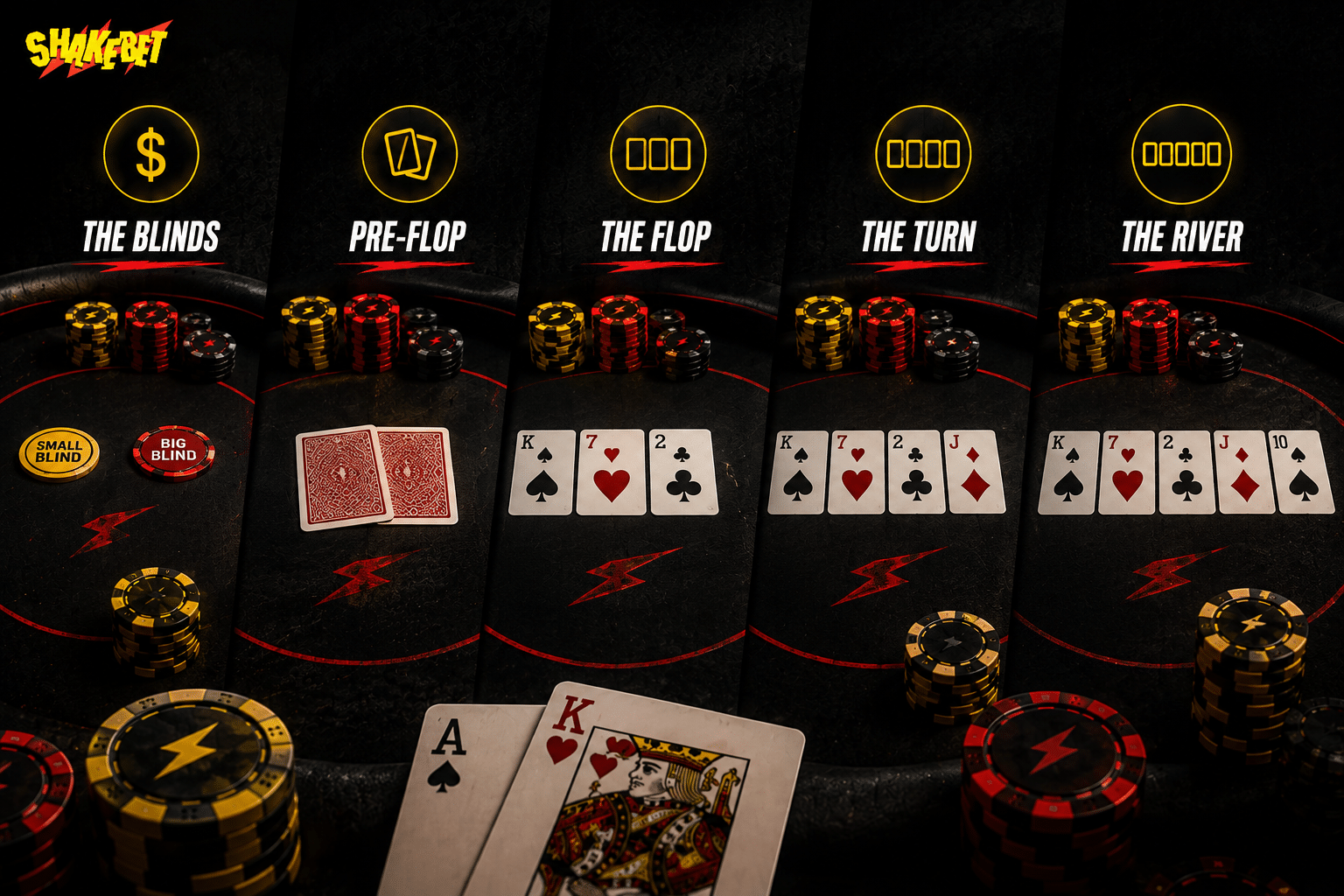
Here is how one complete hand works.
The Blinds
Before the cards are dealt, the first player to the left of the dealer posts the small blind. The next player posts the big blind.
These forced bets place chips in the pot and give everyone something to compete for from the beginning.
Pre-Flop
Each player receives two hole cards face down. The first betting round begins with the player to the left of the big blind.
That player may call the big blind, raise, or fold. If nobody raises, the big blind may check and continue to the flop without adding more chips.
The Flop
The dealer places three community cards face up. Each player now has five available cards when their two hole cards are included.
A second betting round begins with the first active player to the left of the dealer.
The Turn
A fourth community card, called the turn, is dealt face up. Another betting round follows.
In fixed-limit Texas Hold’em, the required betting amount usually increases at this stage.
The River
The river is the fifth and final community card. Players get one last betting round.
If more than one player remains after the action is complete, the hand moves to the showdown.
The Showdown
The remaining players reveal their cards, and the strongest five-card combination wins. A player may use both hole cards, one hole card, or neither.
If a bet or raise goes uncalled, that player wins the pot without having to reveal a hand.
How to Play 5-Card Draw
In 5-Card Draw, every player receives five private cards and there are no community cards. After the first betting round, each active player may discard unwanted cards and draw the same number of replacements.
A second betting round follows. If two or more players remain, they reveal their cards and the strongest hand wins.
Your main decision is what to keep. If you hold a pair of aces, the straightforward play is to keep the pair and draw three new cards. Breaking up a made pair to chase a straight or flush is usually too risky for a beginner because the draw will miss more often than it hits.
How to Play 5-Card Stud
A 5-Card Stud hand begins with one card face down and one card face up for each player. Three more cards are then dealt face up, one at a time, with betting after each deal.
There is no draw and no shared board. Because four of each player’s five cards become visible, observation matters.
Suppose you need a king to improve, but three kings are already showing in other hands. Only one king remains unaccounted for, which makes your draw far less promising. Visible cards help you judge both your own prospects and the hands your opponents may be building.
Wild Cards
A wild card can stand in for another card to complete a hand. Common house rules include deuces wild, one-eyed jacks wild, or a joker acting as a full wild.
In some games, the joker is used as a “bug.” It can act only as an ace or as the card needed to complete a straight or flush.
Wild cards make powerful combinations more common and may allow five of a kind. Before playing, confirm which cards are wild, whether five of a kind is allowed, and whether it ranks above or below a royal flush. House rules decide those details.
Basic Poker Strategy for Beginners
Knowing the rules gets you into the game. Sound strategy stops you from giving away chips while you learn.
These beginner poker tips apply across most variants.
Play Fewer Hands, but Play Them Strongly
Playing too many starting hands is one of the most common beginner mistakes. Weak cards often create difficult decisions and leave you with the second-best hand.
Fold more often and wait for stronger opportunities. When you do enter a pot with a good hand, play it confidently rather than calling passively at every stage.
Position Matters More Than Most Beginners Realise
Acting later gives you more information. You see who checks, who bets, and who appears interested in building the pot before making your own decision.
Suppose three players check and the next player raises. From late position, you know several opponents have shown weakness before one player applied pressure. From early position, you would have acted without seeing any of that.
Understand Pot Odds Before Calling
Pot odds ask a practical question: is the pot large enough compared with the cost of calling? You do not need perfect mental arithmetic to understand the idea.
If the pot contains $100 and calling costs $10, you are receiving 10-to-1 on the call. Chasing a draw may make sense when the potential return is large enough, but not when the call is expensive and your chance of improving is poor.
Do Not Bluff Just to Bluff
A believable bluff tells a consistent story. Your earlier bets should make it plausible that you held a strong hand or that the latest card improved you.
Bluffing several opponents at once is much harder because more players have a chance to call. Choose situations where the board, your position, and the previous betting support the story you are trying to tell.
Pay Attention Even When You Are Not in the Hand
A folded hand still gives you useful information. Watch how opponents bet when they are strong, how they respond to pressure, and which cards they reveal at the showdown.
Patterns are not guarantees, but they add context to later decisions. Players who stop watching as soon as they fold miss the cheapest information available at the table.
Poker Etiquette and Table Rules
Act only when it is your turn and state your decisions clearly, especially when raising. Keep larger-denomination chips visible and place bets neatly in front of you.
Do not throw chips carelessly into the middle. This is known as splashing the pot, and it makes the amount difficult for the dealer or other players to count.
Never reveal or discuss folded cards while a hand is still active. In a casino, the dealer enforces the rules. In a home game, the host should set the standards before play begins.
Agree on the stakes, buy-in rules, breaks, and finishing time in advance. Sorting out those details early prevents arguments when money is already in the pot.

Playing Poker Online
Online poker removes the physical deck and chips, but the decisions remain familiar. ShakeBet’s game library includes video poker titles such as Jacks or Better, while its live games include poker formats such as Casino Hold’em and Three Card Poker.
Video poker is played against a paytable rather than against other players. Live dealer poker usually pits your hand against the dealer under a fixed set of rules.
New players can also review the current first-deposit promotion before playing. Check the eligible games, minimum deposit, wagering requirement, and expiry period rather than assuming every poker title contributes in the same way. ShakeBet currently advertises a first-deposit welcome offer on its official site.