

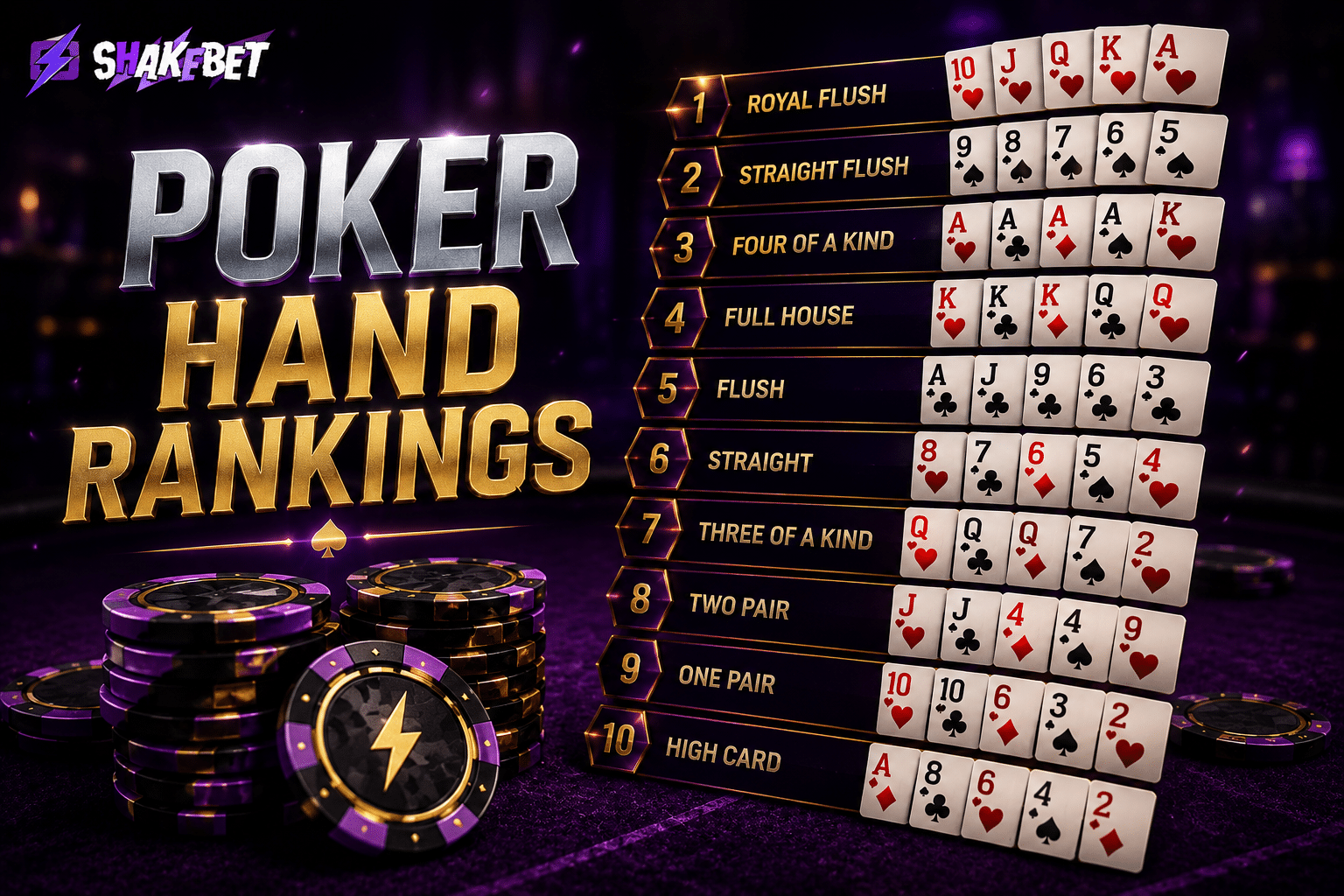
This guide covers all ten poker hand rankings from strongest to weakest. It explains how each hand is formed, how ties are broken, how often different combinations appear and where the usual order changes across poker variants. Keep it nearby while learning the rules or playing at Shakebet.
All Ten Hands, Best to Worst
Poker hands are ranked largely by rarity. The harder a five-card combination is to make, the higher it sits. This standard order applies across Texas Hold’em, Omaha and most traditional variants, regardless of any promotions at Shakebet that may apply to eligible games.
| Rank | Hand | Example | Combinations (5-card) |
|---|---|---|---|
| 1 | Royal Flush | A♠ K♠ Q♠ J♠ 10♠ | 4 |
| 2 | Straight Flush | 9♣ 8♣ 7♣ 6♣ 5♣ | 36 |
| 3 | Four of a Kind | Q♦ Q♠ Q♥ Q♣ 7♦ | 624 |
| 4 | Full House | J♣ J♦ J♠ 8♥ 8♠ | 3,744 |
| 5 | Flush | K♣ 10♣ 8♣ 5♣ 2♣ | 5,108 |
| 6 | Straight | 8♦ 7♠ 6♣ 5♥ 4♦ | 10,200 |
| 7 | Three of a Kind | J♥ J♣ J♦ 9♠ 4♣ | 54,912 |
| 8 | Two Pair | A♠ A♥ 9♦ 9♣ 4♠ | 123,552 |
| 9 | One Pair | K♦ K♣ Q♥ 8♠ 3♦ | 1,098,240 |
| 10 | High Card | A♣ J♦ 9♠ 6♣ 2♥ | 1,302,540 |
Royal Flush
A royal flush contains an ace, king, queen, jack and ten of the same suit. The example A♠ K♠ Q♠ J♠ 10♠ is the strongest possible hand under standard poker rankings and cannot be beaten. If two players use the same royal flush from the community cards, they split the pot.
Straight Flush
A straight flush contains five consecutive cards of the same suit, such as 9♣ 8♣ 7♣ 6♣ 5♣. If two players make straight flushes, the hand with the higher top card wins. For example, a ten-high straight flush beats the nine-high hand shown above.
Four of a Kind
Four of a kind, also called quads, means four cards of the same rank plus one kicker. Q♦ Q♠ Q♥ Q♣ 7♦ is four queens. When the community cards give both players identical quads, the higher fifth card breaks the tie. This situation is possible only in community-card games.
Full House
A full house combines three cards of one rank with two cards of another, as in J♣ J♦ J♠ 8♥ 8♠. When comparing full houses, the three-of-a-kind component comes first. Jacks full of eights therefore beat tens full of aces, despite the second hand containing a higher pair.
Flush
A flush contains five cards of the same suit that do not form a consecutive sequence. K♣ 10♣ 8♣ 5♣ 2♣ is a king-high flush. Suits have equal value, so tied flushes are compared from the highest card down until one hand moves ahead.
Straight
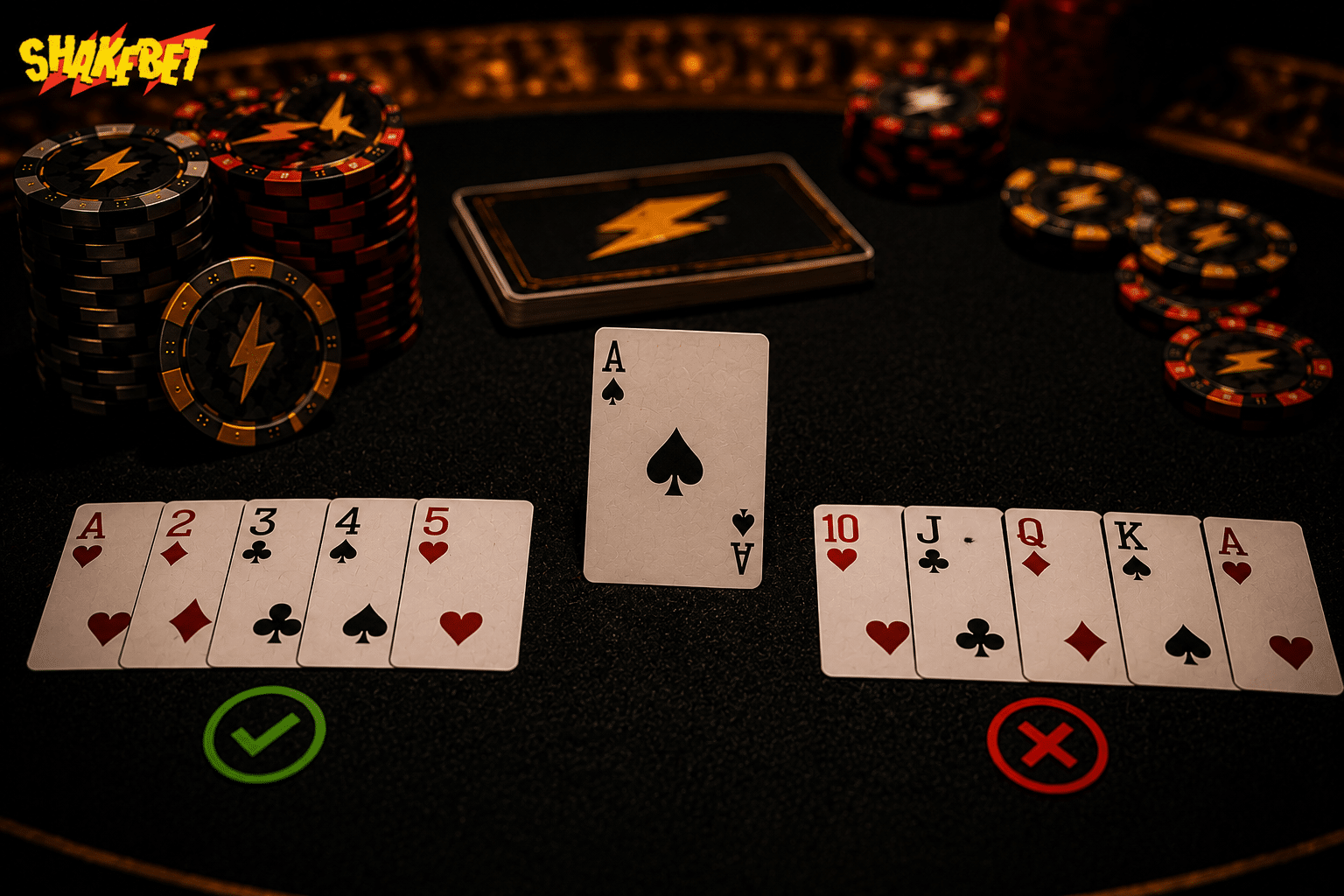
A straight uses five cards in consecutive rank, regardless of suit, such as 8♦ 7♠ 6♣ 5♥ 4♦. The ace may play high in Broadway, A-K-Q-J-10, or low in the wheel, A-2-3-4-5. It cannot wrap around, which means Q-K-A-2-3 is not a valid straight.
Three of a Kind
Three of a kind contains three cards of one rank and two unmatched cards. J♥ J♣ J♦ 9♠ 4♣ is three jacks. “Trips” usually use one hole card with a paired board, while a “set” uses a pocket pair with one matching board card. Higher trips win, followed by the kickers.
Two Pair
Two pair contains two cards of one rank, two of another and one kicker. A♠ A♥ 9♦ 9♣ 4♠ is aces and nines. Compare the higher pair first, followed by the lower pair. If both pairs are identical, the kicker determines the winner.
One Pair
One pair combines two cards of the same rank with three unmatched cards, as in K♦ K♣ Q♥ 8♠ 3♦. It is the most common made hand with clear showdown value. Higher pairs win, while equal pairs are separated by comparing the three kickers from highest to lowest.
High Card
High card applies when the five available cards do not form a pair, straight, flush or stronger combination. A♣ J♦ 9♠ 6♣ 2♥ is ace-high. Compare the highest card first, then move down through the remaining cards until the tie is broken.
How Often Each Hand Actually Appears
The probabilities below apply to a seven-card game such as Texas Hold’em or Seven Card Stud, where the strongest five-card hand is selected from seven available cards. Having two extra cards creates more opportunities to complete each combination than a standard five-card deal.
| Hand | Probability (7-card game) | Roughly 1 in every… |
|---|---|---|
| Royal Flush | 0.0032% | 31,000 hands |
| Straight Flush | 0.0279% | 3,600 hands |
| Four of a Kind | 0.168% | 595 hands |
| Full House | 2.60% | 38 hands |
| Flush | 3.03% | 33 hands |
| Straight | 4.62% | 22 hands |
| Three of a Kind | 4.83% | 21 hands |
| Two Pair | 23.5% | 4 hands |
| One Pair | 43.8% | 2 hands |
| High Card | 17.4% | 6 hands |
Royal flushes and straight flushes are far too rare to form the basis of an everyday strategy. Pairs and two pair appear much more often, so most practical decisions involve judging common hands accurately rather than waiting for something near the top of the table.
When Two Players Hold the Same Hand
Ties occur regularly in community-card games because several players can use the same board. Suits never determine the winner. Compare the hand’s primary element first, followed by its secondary cards or kickers in descending order. If both players have exactly the same best five cards, the pot is split.
| Hand | How to Break the Tie |
|---|---|
| High Card | Compare highest card, then next highest, and so on |
| One Pair | Higher pair wins; if equal, compare kickers from highest to lowest |
| Two Pair | Higher top pair wins; if equal, lower pair; then kicker |
| Three of a Kind | Higher rank wins; if equal, compare kickers |
| Straight | Higher top card wins; A-2-3-4-5 is the lowest straight |
| Flush | Compare highest card down; suits are equal |
| Full House | Higher three-of-a-kind wins; if equal, compare the pair |
| Four of a Kind | Higher rank wins; if equal, higher kicker wins |
| Straight Flush | Higher top card wins |
| Royal Flush | Always a split — all royal flushes are equal |
The Ace: What It Can and Cannot Do in a Straight
The ace has two possible roles in a standard straight. It plays high in Broadway, A-K-Q-J-10, and low in the wheel, A-2-3-4-5. It cannot sit in the middle of a sequence or connect both ends of the deck, so Q-K-A-2-3 does not count.
This wrap-around mistake is common among new players. Outside straights and variant-specific low hands, the ace is treated as the highest card in standard high poker.
Three Hands That Often Catch Players Out
Community-card games frequently produce boards where a strong-looking hand loses to a better combination that is easy to overlook. These three examples show why players need to assess all five community cards rather than focusing only on their own hole cards.
When a Flush Beats a Straight
Suppose the board is 9♥ 8♥ 7♣ 2♥ K♦. Player A holds 10♣ 6♠, giving them a ten-high straight. Player B holds A♥ 5♥ and makes an ace-high heart flush. The flush ranks above the straight, so Player B wins. Players concentrating on their own straight can easily miss the third heart on the board.
When Two Players Share the Best Hand
Consider a board of K♣ K♦ K♥ 8♠ 8♣. The board itself makes a full house, kings full of eights. Player A holds A♠ Q♠ and Player B has J♦ 10♦, but neither player can improve the five community cards. Both therefore use the same full house, and the pot is split equally.
This outcome happens more often than beginners expect, particularly when the board contains a completed straight, flush, full house or two-pair combination.
When a Strong Hand Loses to the Kicker
The board is K♣ K♦ 8♥ 4♠ 2♣. Player A holds A♥ Q♥, while Player B has J♣ 10♣. Both players have a pair of kings, but Player A’s final hand is K-K-A-Q-8. Player B has K-K-J-10-8.
The pair is identical, so the first unmatched card decides the result. Player A wins with the ace kicker. Players often underestimate how frequently a kicker separates two otherwise similar hands.
Where Standard Rankings Change
Most poker variants use the traditional hand hierarchy. However, lowball changes the objective of the game, Short Deck removes several ranks, wild-card formats make an additional hand possible and Three-Card Poker uses a different order based on three-card probabilities.
Lowball: The Rankings Flip
Ace-to-Five lowball ignores straights and flushes, treats aces as low and makes 5-4-3-2-A the best possible hand. This ranking system is used in Razz and for the low half of games such as Omaha Hi/Lo and Stud Hi/Lo.
Deuce-to-Seven lowball keeps aces high and counts straights and flushes against the player. The best hand is an unsuited 7-5-4-3-2. This system is used in games such as 2-7 Single Draw and Triple Draw.
Short Deck: Flush Beats Full House
Short Deck Hold’em, also known as 6+ Hold’em, uses a 36-card deck because all cards below six are removed. With only nine cards in each suit, flushes become harder to complete, so they rank above full houses under common Short Deck rules.
The ace also has a different low-straight role. A-6-7-8-9 is the lowest possible straight in this format.
Wild Card Games: Five of a Kind Is Possible
Wild cards can substitute for another card and create five of a kind, which is impossible in an ordinary 52-card deck. Under the usual wild-card ranking order, five of a kind sits above a royal flush, while the remaining standard categories keep their existing positions.
This rule can appear in games such as Deuces Wild and in home games that include jokers or other designated wild cards. Individual video poker paytables may value combinations differently, so the rules should always be checked before play.
Three-Card Poker: A Straight Beats a Flush
Three-Card Poker reverses the usual relationship between a straight and a flush. With only three cards, a straight is harder to make than a flush, so it ranks higher.
The standard order is straight flush, three of a kind, straight, flush, pair and high card. Three of a kind, sometimes called a prial in other three-card games, is therefore one of the strongest possible hands.
How Rankings Feed Into Actual Decisions at the Table
Poker hand rankings are not merely a list to memorise. They shape how you read starting cards, assess the board and respond to every bet.
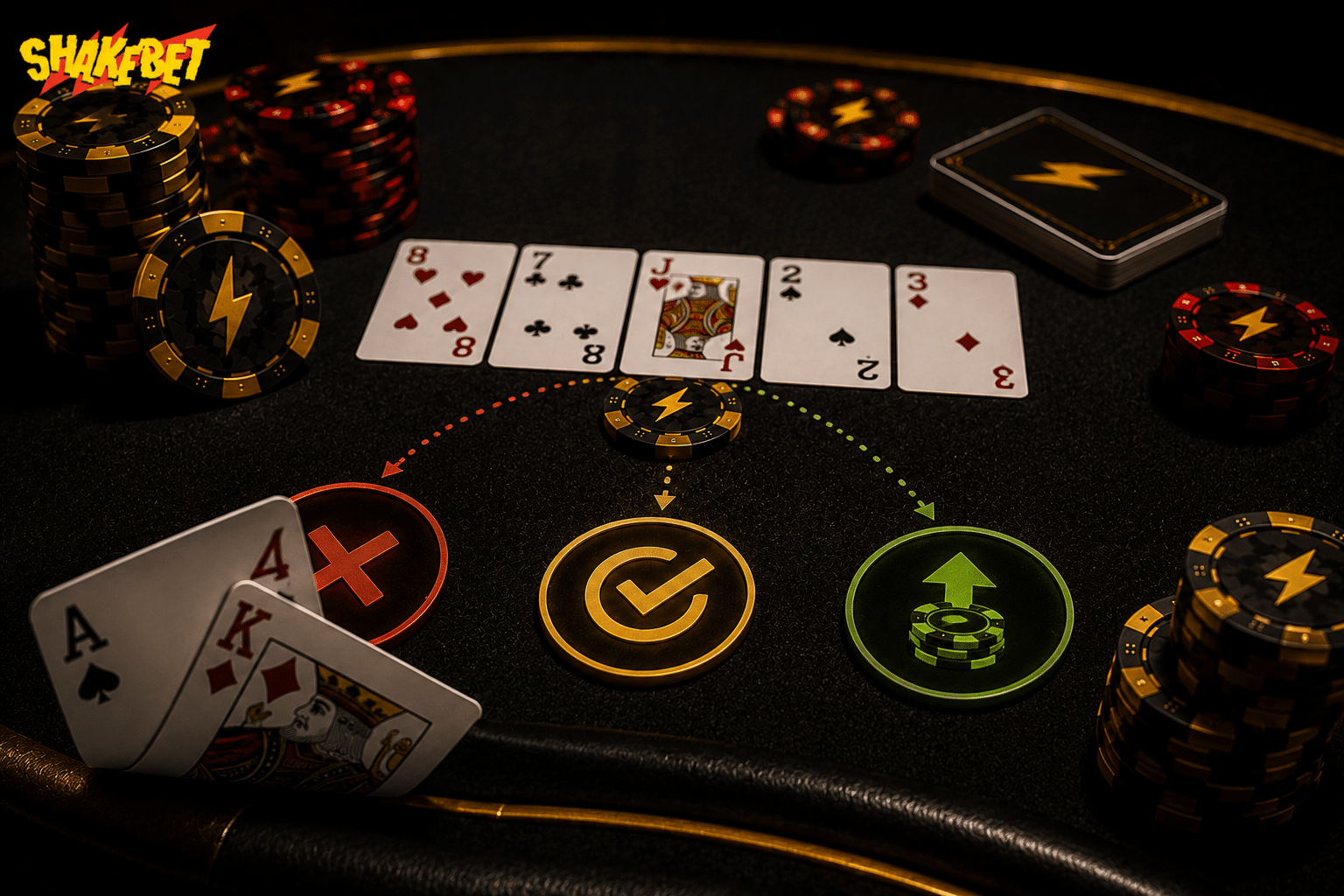
A flush draw can look promising, but four cards of one suit do not yet make a flush. The board still needs to provide the missing suit, so avoid treating a draw like a completed hand. By contrast, top pair can remain strong on a dry board with few connected or suited cards because opponents have fewer obvious ways to make straights, flushes or two pair.
Two pair also needs context. It beats one pair and high card, but it still loses to three of a kind, a straight, a flush and every higher category. Your confidence should depend on the board, the betting action and the stronger hands your opponent could reasonably hold. The ranking chart becomes the lens through which every check, bet, call, raise and fold is assessed.
Keeping the Order in Your Head Under Pressure
The middle of the poker hand order is where many new players hesitate. A practical approach is to divide the rankings into three tiers.
The top tier runs from royal flush through flush. These hands are rare and usually powerful. The middle tier contains a straight and three of a kind, which form a useful dividing line. The bottom tier contains two pair, one pair and high card, the combinations players encounter most often.
You can also build a mnemonic from the first letter of every hand: “Royal sailors find fresh fish; steady travellers take one home.” It follows Royal Flush, Straight Flush, Four of a Kind, Full House, Flush, Straight, Three of a Kind, Two Pair, One Pair and High Card.